Showing posts with label elder scrolls. Show all posts

No more crises in the sandbox

| Tuesday, December 17, 2013
I like urgency in games. I like sandboxes or other non-linear games. I don't like them combined on a large scale. Full disclosure: I used the word sandbox because it sounds better than "No more crises in the non-linear game that also features structured quests" and I'm a paid lobbyist for a national sand and box chain. In related news, silica exposure is an imaginary problem, why do you think crabs don't get lung cancer?

Imagine that a cult is summoning a demon and that this demon is going to more or less destroy the world when it gets here. Certainly you're no going to jump right into saving the world; you are an exceptionally weak mage after all. But after a bit of practice you'd be out there investigating, turning in amulets, and finding bastard offspring. Oblivion is my reference point here, but the general notion is widely applicable in games that allow you to explore while using a crisis as a central plot point. The combination ends up being completely absurd.

The crisis isn't just rumor; it is often directly explained to you. In Oblivion it is what gets you released: the Emperor thinks you're the one who is going to save the world. The world could end tomorrow without your intervention. You opt to join a murder cult and hunt down old trinkets for the nobility. That never showed up in any training montage. Though I suppose it is a bit more directly applicable than painting fences or picking up coats.

Maybe Fallout 3 works better, at being ridiculous. Your father has ditched you and you've been kicked out of your formerly safe home. You set out to find him. But before you save your dad from potential death / reunite with your only family, you first do some things along the way. Some of these make sense: someone has information and wants something in return. There's not much you can do about that. A detour to slaughter a town of slavers or disarm an atomic bomb, that's just what anyone else would do, given the ability. Other things, don't make much sense. Do you leave your dad out there so you can find Future Coke for an addict? What about tackling a housing discrimination case? At some point I started to wonder if my character had an attachment to his father at all, or the reverse, given some of the dialog.

Far Cry 3 features a similar level of insanity. Your friends and one brother have been kidnapped, the other brother killed while you were escaping. Since you're just a jackass frat boy you're not a very good hero for a rescue mission, so logically you spend some time getting tattoos, which in this universe makes you more powerful, so it makes sense. Yet there comes a point when it becomes absurd; you're driving all over the first island for days, capturing pirate outposts, fixing radio towers, and going hunting, and doing nothing at all to rescue your friends or gather intelligence on your enemies. This would at least make some sense if it seemed as if it was the result of the player shaping events through decisions, trying to help the island as a whole before worrying about his friends. The delay is never addressed, and in fact doesn't seem to have happened.

That's one of the persistent oddities in open-world games: what you do in the sandbox stays in the sandbox, while sometimes your actions in the little time bubbles leak out into the sandbox, even undoing your progress or canceling out what you have done.

This is when a more personal (by which I mean selfish) story can come to the rescue, a story based only on the player. In Fallout: New Vegas you get shot in the head and that's about it as far as the main plot goes. You're not destined to save the world. You're just a guy who got shot in the head and probably wants a bit of revenge. Given the difficulty of travel, it's not as if the other guy is going to escape; he thinks you're dead anyway. In this scenario there is no rush at all, so why not go exploring? The world isn't going to wait for you and that's just fine, because as far as you know, you're completely irrelevant.

Or consider a game such as Stalker: Shadow of Chernobyl. You have amnesia and a quest to kill a man, and you don't know from whom. Given that beginning it is not surprising that you'd end up doing some wandering and searching for odd jobs. You're lost in a terribly dangerous place, so making yourself useful to nearby people with information and guns is sensible. Eventually you discover a big mystery and pursue that, but at no point is there a sense that if you're not acting toward goal A, then you're putting your life and the existence of the entire world at risk. Though, it turns out the entire world is at risk, and you might have made things a lot worse, or better, or who can really tell given the strangeness of events in the Zone.

Adding some sort of stagnation/stalemate can help as well. One of my favorite game series ever, Escape Velocity, featured all manner of ongoing wars. But they were stalemates and therefore we could expect them to keep going about as they are without our influence. It helps that in fictional universes outside of Civ IV there is no such thing as war weariness. If the war isn't changing one way or another and you're just another small-time shuttle pilot, why wouldn't you go out and see the galaxy?

We could also look at most MMOs in which something is busily trying to destroy the world, yet for some reason we're off picking apples. Surely the locals would be telling us to get out there and fight. The government would be throwing piles of gold at us to get us back out there. Imagine if General Patton had decided that fighting Rommel just wasn't that pressing and took a detour to go hiking in Peru? We'd have put him in an asylum, or at least threatened to turn the whole operation over to Montgomery, unless the Englishman was off learning the bagpipes as a way to scare rats away from grain silos (if that quest does not yet exist, it should).

I love non-linear games, games where I can choose what to do and when. But when the game is overshadowed by an imminent threat, well that tends to overshadow everything else. It turns side quests from fun distractions into absurd detours that no sane person would start. Yet insanity isn't really an option either, because the games never acknowledge that you were doing anything other than what they told you to do. Instead you're apparently some sort of transubstantialmultidimensionaltwoinone being who is simultaneously inspecting caves for bandits while also not doing so, at either the same time as, before, or after, saving the world.

Don't hide the information that makes your game playable

| Thursday, October 24, 2013
I've previously complained about spell switching in Skyrim. As far as I could tell, and as far as the game told me, it required pausing. Cast, favorites (pause), select (still paused), close menu (action!), cast different spell.
Thankfully, switching spells pauses, so I can switch between the two, but pausing constantly, particularly in the middle of a fight, is lame.  Beside any sense of power, there is the fun, and constantly interrupting the fight is not fun.
Turns out I was wrong, and I'm surprised that I managed to be. In Oblivion there is a hotkey system, which I knew about. In the spell book, hold down 1-8 and click on a spell and it will be bound to that key. Sadly, you cannot actually cast with those keys, but you can at least quickly switch spells without needing to open the spell book constantly. Where was the tutorial popup? I'm certain I saw one about the favorites menu, but somehow, not about the best part about it.

Skyrim uses a similar system, but it appears that you need to add spells to your favorites list first. Then you can open that menu and click a number while mousing over to assign a number to it. Hitting the key then picks that spell. Spells are loaded left to right. The actual spell switching behavior is slightly more complex, not difficult or confusing, though attempting to explain it makes it appear so.

Without this information, casters are garbage. Fully effective, but not even remotely fun to play. With it, they're as seamless to play as any other class and now I'm having a great deal of fun. Of course I'm running into the problem that I wish I had more hot keys, but I've never not had that problem, in any game, except GW2, but that used nested hotkeys which is cheating, and I sometimes find them annoying (due to things like the abilities I use for kiting being spread across skill sets).

Maybe you're wondering now, why am I just now noticing this? Didn't Azuriel tell me this in the comment about a year and a half ago? Yes. Yet somehow it slipped in one eye and out the other. Maybe I just needed practice time, which came in the form of Oblivion because I was feeling nostalgic. Despite my remarkable ability to completely miss the helpful content of a comment that I'd even replied to, I believe that my point still stands: Don't hide the information that makes your game playable!

Indirect Punishment

| Thursday, October 17, 2013
Between the Thieves Guild and the Dark Brotherhood it was obvious that he was on a dark path. Even if he did seem to be trying to save the world from the Mythic Dawn, who could say what sort of world he was saving, or why? Maybe he was only saving it so he could steal it himself, coin by coin.

His killing eventually took its toll. Shopkeepers were dead, their stores ransacked. Homes were plundered and their residents murdered. The streets grew quiet, devoid of souls.

If you asked him why, he'd laugh. "They annoyed me," he might answer. Whether for greed, revenge, or just amusement, he'd kill at will. The bounty wasn't even enough: he was rich and the armor sales offset most, if not all, of the cost. Somewhere was a very busy fence.

Yet, in time, he grew sad. He saw no one but his fence, everyone else was dead, and everything he had was stolen anyway.

It was not karma. There was no karma system. Infamy just made the guards rude. The game never said that he failed a quest. It never said he did anything wrong at all. By its rules he was doing just fine.

With his freedom to change the world, he had changed it for the worse. He had been punished for his crimes, not with a defeat screen, but with his own destroyed world.

His successor learned from his mistakes. He killed only those who were threats, or quests, rather than just annoyances. With one exception, because the Brotherhood isn't for angels. He stole, but did not wipe out entire stores. He kept up appearances. He bought houses and furnished them. To all outside observers he was a paragon of virtue. His world sparkled in a thoroughly non-vampiric manner, for those were dead too. He carried a potion to cure disease. The gods still weren't happy with him, too many murder quests and theft quests, but the gods are little more than an angry whisper at the chapel.

It's like his parents taught him: why slaughter the cow when you can steal the milk for free? The world agreed.

Casual evil in video games

| Wednesday, July 31, 2013
We all know that we can do bad things in games. I'm not referring to people an asshole on xbox live or something like that, but to the actual gameplay. It's not even the obvious stuff that bugs me. Yes, in Grand Theft Auto games you can rob and murder people and that's bad, but what would the game be without that? Without the horrible things you can do the GTA series is really just a bad third person shooter blended with a bad driving simulator. I'm instead concerned about the incidental evil, the bad things you can do that the developers might have not even thought of. Yet it is there.

Take the Elder Scrolls games, for example. As in all fictional worlds, there are no psychiatrists. If you're traumatized, that's it; your mind is done for. Your best option at that point is to just embrace it, join a demonic murder cult, and do what comes naturally. And of course you cannot kill the children. You can, of course, kill their parents. In front of them. And then when the guards come you can kill them too. That kid is done for.

Or in the Civilization series there are the casually-committed war crimes. In Civ III I used to intentionally starve foreign cities I don't know if that actually helped with the cultural conversion, but there were definitely fewer foreigners after I got done with them. I tended to run a thriving slave trade as well. These weren't written into the game to fit some karma meter. There is no karma meter. The closest thing is being a warmongering menace to the world and odds are, whoever is calling you that is himself a warmongering menace to the world. It's the pot calling the can of black paint black.

There's another thing: you can shoot at anything if you're at war with it. Generals, well of course! Admirals, duh. Those are both obvious. And then there are the workers. Guys are just trying to build roads and you're ordering air strikes on then. Maybe a missionary wanders by and what do you do? Open fire!

The best part, at least as I roleplay it, is the reason why: they're bored. There aren't any enemy military units, so they're just firing at anything in sight. Some guy is trying to save souls and they're just lobbing shells at him. Odds are his civilization is some backward dump and he's got this great opportunity to leave and we're just shelling everything in sight. It makes me miss how in Civ IV you could use air strikes against improvements. I'd be doing that constantly. Just shoot up all the farms; get jet fighters with the depleted uranium rounds.

This is all beside the times when I go full Honor and get gold from killing units. At that point I see no reason to ever end a war. Why wouldn't I just keep slaughtering people? It's not costing me anything. I need my army anyway, since I need to defend myself from all the people who are mad that I keep starting wars.

[edit] And since posting this I've destroyed the Zulu empire for the sole purpose of stealing their art.

Headshot! Or, Why FPS PvP MMOs are a Bad Idea

| Monday, June 18, 2012
As I pointed out last week, my new header is a modified wallpaper from Stalker.  Because they're awesome (the game and the wallpaper, but this post is based on the game). It's an FPS, but with RPG elements such as currency, inventory, and quests, as well as taking place in a mostly open world. FPS + RPG = Awesome game.

I also think it could be a blast to play with friends. The game generates AI teams which do, approximately, what players would do: explore, search for artifacts, loot, fight bandits and mutants, and run for their lives when the Daily Everything Dies event is coming. Best daily quest ever. It's a world already designed for groups to exist, so being able to bring in friends seems like the logical next step.

Just as long as we cannot shoot each other.

I'm not suggesting that there should be no friendly fire. It's part of the challenge, when mutant dogs are darting around, to track them without hitting friendlies. But players should not be the enemy.

We've all had it happen, or at least are familiar enough that I can pretend: you're at some small level running around when seemingly out of nowhere you die. Maybe it was a rogue stealthed, a hunter far away, or a warrior whose charge-swing came so fast that you couldn't register what had happened. Whatever the specifics, the same general event happened: a much higher-level player killed you instantly, with no chance to retaliate. It's an annoying side-effect on level-based MMOs with PvP, but little more than that because it is a temporary state: merely leveling up will fix it (though gear imbalances continue the problem, those are for another day).

Imagine if that was instead the standard form of interaction. In Stalker I might take down a team of enemies in a few seconds, at long range. At the least, it would be trivial to take down one and fall back, untouched. Obviously this is fun for me, but is it any fun for other players? We don't like losing, but this is beyond losing, this is essentially random death, which you cannot out-level or out-gear. At best you can become incredibly paranoid or refuse to leave any safe areas. Not much fun.

The RPG solution is to allow you to out-level and out-gear it, so that you react to the bullets in the FPS the same way you'd react to a hunter's auto-shot, by taking damage, but almost certainly not being instantly dead. Now the sniper is trying to pull off a dozen headshots to kill someone. Now he's just wandering into a 3v1 with a minor advantage from getting the first attack, but he's not all that much better off than if he'd just wandered right up to them. All his careful sneaky hunting is a waste of time.

At least for me, part of the appeal of FPS games is the feedback. Shoot, kill. No miss table, no wondering if the enemy will survive because of armor. When a bullet hits you in the head, you die. Or more accurately, they die (from the bullet in their head). The carefully aimed first shot can be the only shot, a reward for being careful and sneaky. This is also why most FPS don't appeal to me, because so often you can put a full clip into someone's chest and they don't die, turning it into a weird punching match. TF2 is the exception because it makes no pretense of reality, embracing the absurdity of it all.

Maybe the S is the problem, and rather than First Person Shooter it should be First Person Speller, where you say words at enemies and if they can't spell them fast enough they die.  Sorry, I guess I should have gone with the less ambiguous First Person Sorcerer, where you throw spells at people's heads.  In this case, a perfectly-plausible "a wizard, that is to say, your character, did it" explanation can explain why a magic bolt to the head isn't deadly.  It may even offer more variation.  Frost magic to the feet slows their movement, to the arms slows their attack, chest slows their breathing so they get tired faster, and to the head slows their casting because of a terrible brain freeze, but without delicious ice cream.  Healing or counter-spells could require similar targeting, so a fireball into the skull of your friend isn't going to do him any good, but into his frozen legs it will get him running again.  This would mean that a dedicated healer/buffer class wouldn't be needed, since rather than making different spells for different targets, instead the spells would have different effects based on what they hit and where.

Okay then, is anyone making a First Person Sorcerer?

Why would I want to press that button?

| Monday, May 28, 2012
Skyrim has some pretty awesome spells.  Skyrim has some pretty awesome kill animations, especially for melee, though seeing a pair of firebolts hit the chest of a necromancer in slow motion  and send him flying, that's pretty awesome too.

I've played a stabby sort of character who sneaks up and stabs people.  I was good at stabbing people.  Or sometimes it was more of a cutting motion.  It seemed to make the necks of my enemies happy.

I'm currently playing a tank: daedric plate armor, heavy shield, sword, and a build based on hitting things with my shield.  I can swing my shield.  I can swing my shield harder.  I can run while holding my shield and send people flying.  I really like areas with cliffs.  If I'm not in a shield sort of mood, I sometimes shop people's heads off.  I'd tried this sort of thing in Oblivion, but it didn't work very well; I just had terrible damage.  Shields weren't nearly as useful back then.

Sometime I want to try using a two-handed weapon.  Watching Lydia, the animations seem pretty nifty, and with the block I can hit people with the pommel, which as we all know, is awesome.

Skyrim has some fantastic melee.

Skyrim also has some fantastic spells.  I can scare my enemies, make them stop attacking, make them attack each other, banish daedra, summon daedra, place traps, surround myself in flames, shield myself from damage...  I can adapt to a million situations.  Or none.

Until I start enchanting, my damage doesn't scale.  Melee can pick up new weapons and bam, higher damage.  In contrast, finding fancy new robes allows me to... cast spells slightly more cheaply.  Yea, because we go OOM constantly.  That's not sarcasm.  That's how sad it is, that just not going OOM as soon is an upgrade.  Not doing more damage per second, just being able to throw flames for a few extra seconds.  Admittedly, a caster can eventually get to the point of having free spells with the right enchanting, but that's a bit lame if you ask me.  Free crap isn't better!  It reminds me of when I made my sneaky type in Oblivion, where thanks to the awful stealth mechanic, I was terrible.  I got around that by enchanting my armor to the point that I was completely camouflaged and therefore effectively invisible.  Abusing a game mechanic doesn't really seem like the funnest way to do things.  On top of that, enchanting isn't mage-only, so my melee can use it too, to great effect.  Meanwhile, a mage could pick up blacksmithing for more durability, but if he wants to get the real damage gains, he's going into the melee trees, at which point, why is he a mage?

But at least I have my perks!  Let's see: cheaper spells.  More cheaper spells (by which I mean additional spells, rather than spells which are "more cheaper").  Ooh, I can double-cast for extra damage and further along it does a stagger effect.  But double-casting means I'm no longer able to multi-task.  I can nuke hard or heal hard.  Thankfully, switching spells pauses, so I can switch between the two, but pausing constantly, particularly in the middle of a fight, is lame.  Beside any sense of power, there is the fun, and constantly interrupting the fight is not fun.  Contrast that with my melee who blocks with right-click, can switch to attacking by the simple action of no longer holding down the right mouse and using the highly-complex left mouse button to attack.  Or in my case, thanks to my perks, I don't even have to stop blocking; I can left click while blocking to hit people with my shield, dealing modest damage and interrupting casting and power attacks.  Jumping back to the perks: melee perks give added damage, more added damage, neat tricks with my shield, and cheaper power attacks for one or two-handed weapons (no luck for shields, but that's okay).

Meanwhile my summons are... well maybe eventually they're good, but currently, my wolf dies in about two hits, if it doesn't run away first.  Yea, but summoned familiar flees the battle.  Or maybe that's the AI switching to a really far away target.  Either way, it's useless.  But at least I have my companion for a tank, who can then die to my spells if I'm not careful.  I could reposition, but if she's not between me and the enemy, she's not really blocking them, since there are no taunts.

Much of the problem is one of interface.  Because spells are 'equipped' rather than based on hotkeys, switching spells uses the same interface as switching weapons.  I don't have to switch weapons very often unless I'm going from sword to bow, which will happen maybe a couple times in a long fight.  Spells, much more often.  All those neat effects I named, those need a switch, so I fury one enemy and fear another (so far it's one per hand, so I'm alright), and then if I want to attack or defend, I have to switch, and then back if I need a new fear.  On the plus side, if this doesn't all go correctly, thanks to my cloth and low health pool (I need magicka) I am probably already dead.  Wait... that's not a plus side.

It got so bad that I started starting Skyrim, glancing around for a few seconds, considering finding a cave of bad things to fight, and then quitting.  Skyrim was just plain not fun anymore.  The thought of playing it made me slightly uneasy.  It was repulsive.

Then I did the smart thing and stuck the saved games for my mage in a folder and pulled out my shield-smasher again.  And went off to smash people with my shield.  Fun again!

The mage just doesn't have particularly good buttons.  Maybe the problem is that it doesn't have buttons.

On the other hand, maybe the problem is that the situation is too similar to this old video from a long time ago in an Orgrimmar a long time ago.

World of Roguecraft, Episode Three (I'd embed, but that's blocked)  I did not make this video (I'm not that awesome), but the rogue does talk a bit like I do when frustrated.

Take note of what they say: the warlock (mage) doesn't gain much from stats while the rogue (melee) does.  The rogue can get a huge damage upgrade just from a new weapon.  The rogue claims that they "need that extra crit chance because our moves don't do as much as casters", which if we pretend that he said "hit" instead of crit, then we can compare the similar damage output, but the fact that unless the enemy is in your face, bolts can miss.  In terms of acquiring gear, the mage is going to have to enchant to get far (do the robes that drop ever stop being terrible?) whereas the melee can pick up whatever their enemy drops.  Though it's not quite as bad as the warlock, since if you do get an 'epic' staff, you can wield two staves of fireballs, which are pretty damn amazing.  Though unless you get lucky from a chest, getting one means fighting something that already has it, and those things hurt!

I know some of you people play Skyrim, so I put this question to you: do mages become fun?  How?  How long does it take?  Should I quit whining and glue myself to an enchanting table?

"Hey look, a cave. I wonder what's in it..."

| Friday, May 25, 2012
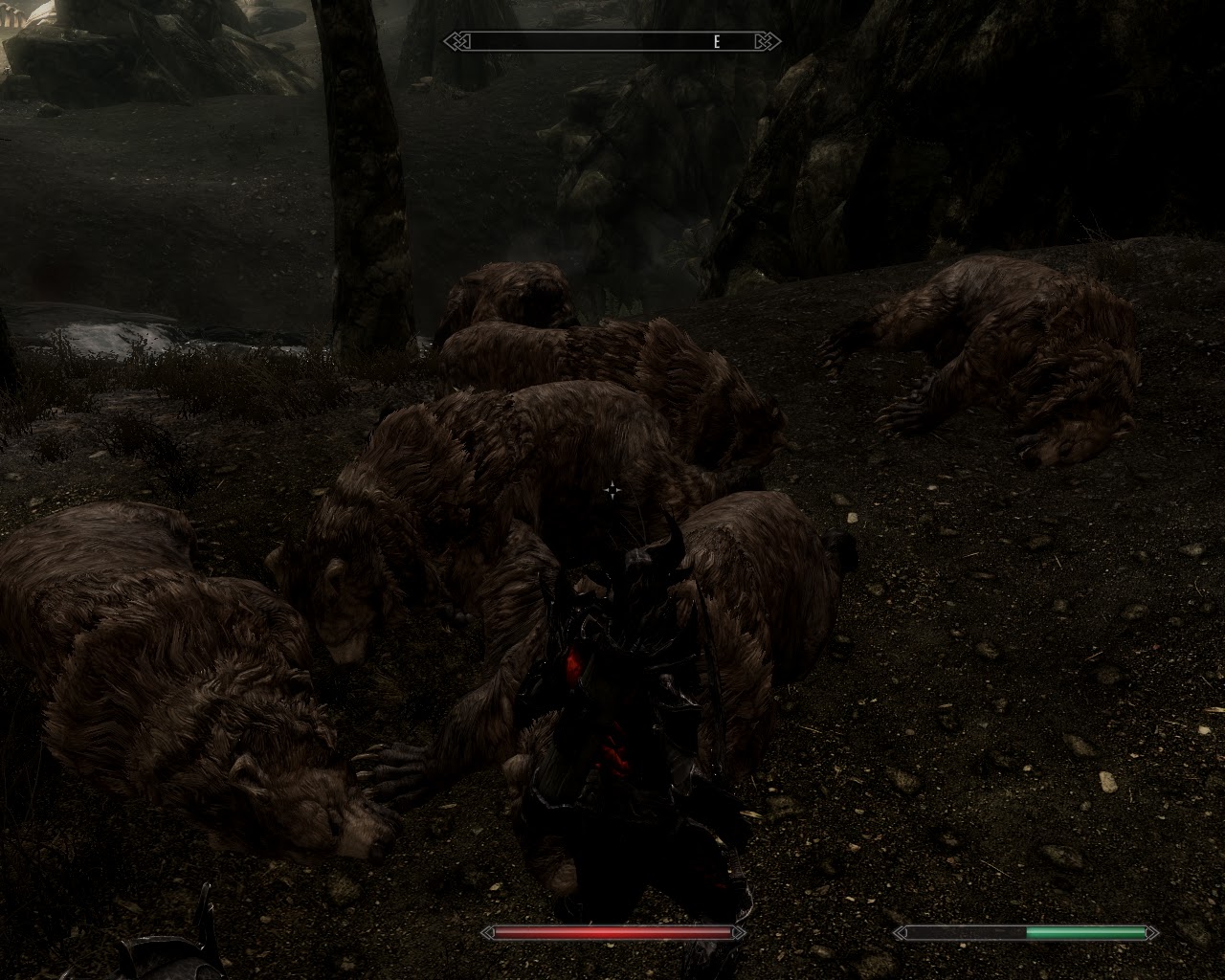
There I was, looting the pelt off a bear, when all of a sudden, all these bears show up.

All his best friends!
Weird.

I shoot an arrow in the air and where it lands I know where. (a knee)

| Wednesday, May 23, 2012
I've said it before about Oblivion and I'm saying it again about Skyrim (but more): I like wandering around.

There are, of course, the quests.  I do those.  I like the sense of direction they give.  But I don't get teleported to the quest hub.  I can fast travel to somewhere near the quest location, but after that, I have some travel to do.  So I travel.  Sometimes in the direct direction.  Sometimes toward the dragon shrine that popped up as being somewhat nearby.  Sometimes in circles as I chase down the dragon that clearly wants to fight me but keeps landing somewhere else to fight bears.  Poor thing doesn't know what it wants.

I wander and as I wander, I wander across.  I wander across caves and castles and within the caves and castles I may fight bears and bandits, though not usually in the same place.  These bears and bandits are not a burdensome challenge nor a fount of bountiful loot, but I get to hit people in the face with my shield and that is enough.

That's the nice thing about the leveling system: it levels with you.  I level up and thanks to that I can do cool new things such as block magic damage with my shield.  The NPCs follow with.  So I get stronger and so do they and I do it a little bit faster.  Fire mages still hurt and a pair can often kill me.  Cleansing the Shrine of Meridia was difficult (not a fire mage, but a tricky one anyway), but turning into a werewolf helped, except the time I took a full blast right out the door.

This creates an excellent hybrid system in which I can either follow some rails for a Developer-Approved quest line or I can wander off into the world.  If I want to just engage in some violence, I can wander off and find it.  If the possibilities overwhelm me, I can follow the quest arrows.

A too-strict leveling system doesn't allow for this.  If I am level 50 and the area is level 10, there will be nothing to gain from it.  Loot will be too weak, quest rewards too small, and enemies so trivial as to be like gnats, but without the high miss rate when swatting at gnats.  Under an excessively strict system you move in the Developer-Approved areas and leave them when they tell you to.  This is needed in some cases where zones are chronologically linear, that is, that the story in zone B comes after the story zone A and assumes you've done certain things in zone A.  In that case, making zone A level 15 and zone B level 20 is an easy way to ensure that I do the story in the order that makes sense.  That's fine.  It is not without cost.

There is a way around it, to keep the zones all parallel in time, but maintaining grand narratives.  One way is to make the isolated content, the instances or dungeons, longer and able to run stories on their own.  Another is to make the stories old, make them bits and pieces that we discover, and in that way, can always make sense.  Maybe we find the ending first and wonder how it happened.  Or we find the beginning first and wonder how it ended.  Maybe we find the middle and we have this strange tension of not knowing how it began or how it ends.  That drives us to complete the story, but does not mandate any particular order or direction, while still perhaps pointing us to places we'd want to go.

Now if you'll excuse me, that castle looks a bit suspicious...

Picking your resource pool

| Monday, January 16, 2012
Why am I predicting that my paladin in Skyrim won't work well? Resources. I need to divide my levels between health, magicka, and stamina.

The paladin would use melee attacks for most damage with strong healing to keep him alive as he wades into large groups of enemies. Melee attacks drain stamina. Healing uses magicka. Getting punched in the face uses health. That means I have to keep all three fairly high, or else I'll find myself lacking in damage, healing (health), or health, one of which contributes to enemies being alive, which means that indirectly, all three are factors in whether I die, which is usually a bad thing.

It's not really the base pool that concerns me. A bit extra or lacking here or there isn't my concern. Instead it is the regeneration that worries me. If I increase my magicka regen, that only affects half my resource pools (I'm dropping the concept of health as a resource). My melee is not helped. Or on the other side, more stamina regeneration does nothing for my healing. This means that I must balance my gear for two pools, always risking depleting one or the other too soon, with no ability to correct the problem.

Contrast this with a mage whose damage uses magicka and whose healing also uses magicka, so that the single stat is perfectly flexible. A shortage of damage can be made up for by risking lower health, while a lack of healing means a temporary reduction in damage.

It doesn't help that caster gear tends to be robes rather than heavy plate. Enchanting can help with this, so I'll leave it as a "player problem" rather than a "developer problem".

The Solution
Allow players to pick which pools are consumed by resources.

Change my physical attacks so that they use magicka. We can pretend that I'm not swinging my arms and sword with muscles, but magic, making it a sort of short-range telekinesis. A wizard did it!

For casters, allow destruction spells to consume health. This creates an interesting scenario where their health rapidly fluctuates, with enemy damage and destruction spells hurting them, interrupted for the magicka-using heals to renew it. Or they use the magicka for alteration and conjuration, supplementing their offense even more, but at a terrible cost. This would be a great setup for a warlock.

Skyrim gets rogues right

| Monday, January 9, 2012
This cannot possibly go badly.

I was expecting to get one decent hit, and then promptly get flattened.

Instead, my rogue was fast. Very fast. He got off a solid hit, then followed it up with a slash and a finisher, with the giant dead before it could respond.

He's certainly squishier than the paladin I hope to make someday, for which I have low expectations (melee and healing don't seem to mix well, ever). While he has more armor than my mage, he's stuck in melee for damage and is less mobile (no fast bow movement yet), with pitiful healing as well. It's not all bad news. Shields seem to actually do something, not just blocking, since the bash ability has many uses, from interrupt to set-up for counter-attack.

It's the stealth that ruins rogues. In WoW it is the absurdity of combat, that strangest of mechanics which gives mobs the amazing ability to always know my exact location, regardless of line of sight, light, and noise. Once in combat it is often impossible to get out until one side is entirely dead. Being in combat negates stealth and sneaking. If you're not sneaking, why are you a rogue?

Skyrim actually pulled it off. Enemies may be alerted, without being omniscient, though I have noticed that they are sometimes at the opposite extreme, searching in the exact wrong direction: "I think I saw something! Over here in this brightly lit corner behind me, nowhere near those suspiciously well-placed shadows where if I squint I can just barely make out the silhouette of an elf." Even if they spot me they are not permanently on my tail. But I might question why, if someone next to them just died to an arrow to the chest, they would ever revert to a fully relaxed state. I'm not saying they would be permanently hunting for me, but the order of events should never go like this:

1 - Fellow bandit dies to arrow in the chest (knee wounds, while notoriously debilitating, also also rarely fatal)
2 - "What was that?"
3 - NYD bandit wanders around a bit, looking for something.
4 - NYD bandit returns to corpse of dead fellow bandit
5 - "I guess it was nothing."

My rogue feels right. He can sneak around and pick of targets here and there. He avoids groups when possible, waiting for wandering members to be isolated. He can, if things get really bad, go toe-to-toe with enemies, but it is not a pretty process. When fighting wolves, one of the finishing moves is to kick them before stabbing them. It really helps reinforce the idea that my character is a huge jerk.

This one time, he killed an entire instance full of bandits, except one guy, patrolling near the middle. Now he can finish his patrol and know that not only is everyone dead, but that he's surrounded by the corpses, and surrounded by his own failure as a guard. I'm imagining him as an utterly broken man. Or, if he's like me, he's looting their corpses and throwing out the bits that have a low value/weight ratio. I hope he's not like me. I frighten myself. It's pretty hit or miss if I kill everyone in a place or if I only kill the one and only one target, leaving all the rest leaderless and shocked. I killed a woman at her wedding. Then I stole her wedding dress. My first ever murder was a bard who charged too much for his awful singing. When told to pick who should die in order to join the Dark Brotherhood I killed all three of them, but picked the woman with the family first. Sometimes I beat rabbits to death to steal their souls, in order to recharge my mace that steals souls, which was gifted to me by a definitely evil demon prince.

Oh yea, screw stealth, what's the point of being a rogue if you can't be an utterly evil person? Maybe I should try this Star Wars game; I've heard it has some unsavory classes.

I thought I was bored with dragons

| Friday, January 6, 2012
But these people showed me a whole new level of indifference.


Afterward their only remark was "ooh, shiny" as I healed myself up a bit.

In related news, I love the random killing blow animations. With that demonic mace I'm using they look especially effective. It's quite a fun weapon to use, nice and solid with enough spiky bits to make it clear that whoever just got hit is, at best, in crippling pain. My favorite part is when they are almost dead and stagger a bit saying how they give up, and then I beat them again and see their soul get torn out.

My 5-5-5 Plan

| Thursday, January 5, 2012
What I'm currently playing: Elder Scrolls V: Skyrim, Civilization V, and Poker Night at the Inventory, which has five players and is only here so I could get a third five.

Here and there I read annoyance or anger over the habit of publishers to stick to just a few franchises and slightly tweak them over and over for massive profits. I think that's not at all the problem.

Here I am playing the fifth in two series, after having played the fourth, and in the case of Civilization, the third (I won't count my brief time with Civ II). I like these series. Are they just incremental steps in the series rather than innovative new games breaking new ground? Well, yes. What's wrong with that?

The Civilization series has it's formula: build cities, kill everyone else, rule the world, using a mix of city management and planning as well as military strategy and tactics. Until V it didn't have any major deviations from this formula. Sure, IV added some features and the expansions added more and we got more nuances to the civilizations, but ultimately it was the same general game. V brought the biggest change with the wargame-like combat, for which it ended up receiving criticism. Maybe it wasn't innovation, but it certainly ended up being an argument against change. People knew what Civilization was and that's what they wanted. And there's the whole reason for the franchises, at least on the consumer side: we know what we're getting. I know that some companies consistently make good games and some series are consistently good.

Similarly, as I see it, Skyrim is a much prettier Oblivion with some nice added mechanics, but it is essentially the same game. I don't mind this at all. Oblivion was a fantastic game for me and so far, Skyrim is performing well. The fact that it was not a dramatically different game was what sold me on it: I knew what I was getting and I knew that was a gameplay and type of story that I enjoyed.

I think the true problem is this: first person shooters and sports games. They're stagnant. I believe that they are doomed to be stagnant, at least until something changes dramatically. "Shoot guys in this hallway" has its limits. Crysis pushed this out by often giving an island rather than a hallway, and I commend it for that, but that's a harder model to go with and I don't think it is going to catch on. Open areas are harder on the game, harder on the AI, and frankly, I think many people don't even want that much flexibility. I know I played the Halo demo for a long time because it offered convenient point and click violence, without much need for planning or any thought at all.

I do like the shooting people gameplay, but the typical hallway shooting just doesn't do much for me. It's too scripted, too restricted, and in general, lasts only a few hours. I don't see much sense in paying $50 for an afternoon or two. Maybe I'm just spoiled by too much WoW, which as linear as it has become, is still a wide-open sandbox compared to 99% of FPS. Maybe that's why I enjoyed the Stalker games so much, for their combination of shooting people and sandbox.

I don't like sports games much because unless they go in the silly direction, such as anything featuring Mario or that one NBA game we played back on the N64 (Hang Time?), they just seem stupid. This is of course, my opinion, which is how we know it is correct.

You probably noticed that I'm leaving out that all-important multi-player experience. No one is paying $50 for a few hours of scripted AI. They're paying $50 for months or years of online play with friends and enemies. That's great, but it's not for me. So for me, a single-player player, they aren't worthwhile.

We've now established that franchises are good, except when they make games I don't like. Why would anyone make these bad franchises and why would anyone buy them? Well obviously, they make them because people buy them, like in the classic movie: "if they come, you will build it." So why buy them? If the previous game was playable and fun, why buy the new one if it is only incrementally better? Slightly better for a few hours of single-player isn't worth it, but slightly better over months or years of play, now that is worth it.

But why not make a much better game? Because that's harder! And riskier. Franchises are safe. Customers know what they are getting and companies know what to make. New ideas might not work. Putting major changes into an existing franchise risks its security. Putting them into a new title risks a lot of money, and who will be the customers except the people already buying the incremental upgrade? It's risk with little reward.

Now if you'll excuse me, I need to go back to Skyrim and ponder why the Dwemer ruins remind me of a combination of Gnomeregan and Titan ruins, complete with their own degenerate race that breaks through walls to kill everyone, which look like exceptionally ugly elves.

Skyrim: Porn Edition

| Monday, January 2, 2012
Add a second to the tally of lonely women living in the middle of nowhere who suggest staying a while and complaining that the guards never give any alone time.

Skyrim has made quests a bit more interesting, even more so than they were in Oblivion, relative to choiceless quests so often found in extremely popular MMORPGs. I first heard this in relation to the Dark Brotherhood line, which didn't surprise me, since the quests in Oblivion were some of the best in the game, competing only with the Thief's Guild for general awesomeness. Let me put it this way, when dealing with chaotic, but not necessarily evil demons, it is very hard to actually anger them, so feel free to follow your own path.

Crafting is now done with equipment at locations, such as forges, cooking pots, and alchemy tables. Also, there is not crafting that does not involve turning corn and rice into stamina potions. I don't know yet if I will care much about the expanded crafting system, but I suspect I'll learn more when I make my second character. At some point I hope to make a rogue sort of evil guy, who follows the right path overall (saves the world) but in the wrong way (kills half of it for fun).

I forgot to mention the assistant at the inn in Falkreath. She's very friendly. Friendly. You know what I mean. The first lonely woman I ran into seemed fine. Family got killed, she killed the killer, so now she lives in the woods, surviving despite people trying to kill her. Strong. It seems perfectly reasonable that she'd be a bit lonely, given her years of isolation excluding bandits. If this was a party-based game like Dragon Age, that seems like a set-up to recruit a party member. Then I ran into the inn assistant who insisted on pointing out what a big strong man I am. Maybe that's her job. She seemed to be wearing a strange mix of warm clothes and exposed legs and cleavage that made me suspect that it is her job to flirt with customers while not freezing to death. Then there was the woman at the inn, who wanted me to stay a while, despite not renting any rooms.

I'm not sure what to make of the politics in Falkreath. On one hand, the new Jarl seems like the corrupt type to push out his uncle to be the big fish. On the other hand, the uncle also seems a bit paranoid, so maybe it was a legitimate move to remove him. There does seem to be a lot of imperial activity, understandable given the rebellion, and with a rebellion, it seems like a good idea to install puppets.

Speaking of rebellions, I don't think there are quite enough to keep track of. We've got the Talos agitators, the Forsworn who are whining about being conquered thousands of years ago, the Stormcloaks who want independence, but are also enemies of the Forsworn, the corrupt Silver-Bloods who make the Koch brothers look like upstanding citizens, and of course, rumors of a dragonborn, which mostly means the guards ask me to stop shouting so much. Yea, they want me to stop shouting. Once right after I killed the dragon that would have turned their little town to ashes.

I think I've been playing WoW too long, because I figured, if guy tells you to join in the prison escape, you join in the prison escape. I didn't recognize that I could stab him during the process. So now there's some crazed racist guy running around worshipping demons. At least most of his friends seem to have died and I didn't get blamed for the three guards I killed or the dozen or so people I was framed for killing, or in a dozen or so cases, actually killed. What I'm trying to say is that all the killing was justified and the only unjustified one was a frame. I had nothing to do with it! Honest!

Speaking of hijinks ensuing, I got into a drinking contest. I figured it would be like the punching contests, but with alcohol. Instead I woke up finding that I had trashed a temple and fondled their statues. And at some point I kidnapped a goat and sold it to a giant. Sanguine's Rose was a much more interesting weapon in Oblivion.

So yadda yadda killing thousands of more people, next thing I know I'm a thane or two and I've got this woman following me around carrying stuff when I ask. I figured I should visit the mage college and along the way got attacked by a dragon. Somehow this particular fight didn't go very well. I found myself caught in a full blast staying alive with heals, but without the mana to retaliate safely. Then it died. I had some running to do, on account of not wanting to get hit by the giant either.

Between feeling lazy over the holidays and playing Skyrim for the majority of the hours in the day, I'm probably going to be posting infrequently still. Maybe Wednesday I'll try to find all the things Skyrim does better than Oblivion and see if I can find anything it does worse. Before I forget: merchants having limited gold available makes a lot more sense than the Oblivion model of limited gold per transaction, but it sure is annoying at some times, especially early on when I found myself stuck in some little nothing town. That's what I get for wandering off the first chance I got. Maybe that's why the start of the game has me literally tied up; it was the only way to ensure I'd do at least something when I was supposed to.

A Wander Through Skyrim, part one of too many

| Saturday, December 31, 2011
Rather than try to rehash my half-formed and half-forgotten thoughts after the fact, I'm going to do what I did with my WoW starter posts, that is, constantly interrupt myself to write down what I'm thinking of the action at the time. I suppose if someone read deeply enough into these posts they'd be like a walkthrough of a sort. A really useless walkthrough.

I don't like "action" at the start of games. I'm in a new world with a new game and having to run around at the start tends to disorient me. Oblivion had a much better first start, sticking me in a small cage for a while while Captain Picard talked about stars. And I couldn't quite hear the dialogue early on ad had to put my system volume much higher, with the game already maxed out. I expect to be deafened if I play anything else (take note of the use of if vs. when and consider it part of the review). It feels a bit like Oblivion with prettier graphics and an inexplicably worse interface. That's an impressive feat, given that Oblivion already had a pretty bad interface, particularly for spells. At least now it seems to break them up better into restoration vs. destruction (Are there no other types? Don't answer) whereas Oblivion seemed to have "all powers" "active effects" and "random assortment of some of the powers".

The continuous casting is pretty nice so far. I can't explain why, but I like the feel up of it more than the magical quanta of Oblivion. On the other hand, holding up my glowing hands constantly makes me wonder when I'm going to hear a crackling voice over the radio, "Hit em with the combo! Zap em and whack em!"

My first death came early on, when I was picking up a cabbage. I couldn't quite get the other, so I tried to jump onto the cart for a better angle. Then the physics engine woke up on the wrong side of the bed, stuck me through the cart, and threw us both against the wall until I was dead. Thankfully, I quicksave compulsively after even the most minor of events (excluding death by cart), so I wasn't set back very far.

So stuff happens and I kill a bear with an arrow in the knee and next thing I'm being told we should split up but meet him at such as such place where his father works or something and I'm thinking:
1) We just met and you think we need to break up?
2) Not that there's anything wrong with that, but I'm not into men.
3) We just met and you want me to meet your father? Woah, slow down there!

So I did the logical thing and wandered off aimlessly. I caught some flowers and killed a couple bandits. Then I met some hit woman living in the mountains where I was searching for a dragon. She taught me to shoot a bow and I didn't kill her. Then I wandered some more and died a few times to a Sprig monster that seemed to kill me with magical floating bugs. But eventually I wandered into a town and did my first alchemy and got annoyed that it gives the option to randomly combine ingredients when none have known effects, failing to carefully explain to the noob that you're supposed to eat the ingredients raw and if they don't kill you, use them for potions. So I ate a bunch of stuff and then needed some healing. Then I went off to kill a great beast and wandered into a cave that I should have guessed was a bad place to be, based on the large quantities of blood. Shriekwind Bastion isn't exactly an inviting name either.

Things were going quite well until I found myself incapable of seeing the chain to opena door. Eventually I googled it and got through, but this annoyed me, to be searching outside for information. Then I ran into a master vampire who demonstrated a remarkable ability to kill me in three hits on the middle difficulty while also being faster. I searched again and didn't find anything special beside him supposedly being vulnerable to fire, and yet he was still taking a long while to die to my double-casted fire, or at least a long while relative to the three seconds needed to kill me. Even after putting the difficulty at the lowest I found myself chugging potions to get him down. I guess that's a boss? Maybe I'm not supposed to be here at level 3.

More later, but that's enough of this round of rambling.

Future Research Outside the Continuum of Established In-Game Reality

| Tuesday, November 22, 2011
Let's all pretend this is about Skyrim and not Oblivion so I can feel hip and with it. 'K? Good.

Yesterday I wrote that when we get information later in game can matter earlier, turning what would normally be "additional research" into "outside research". This specific subset might be classified well as "future research". It's not that our characters cannot do it, they just need time travel.

Enter Klepsacovic, the destruction, restoration, alteration mage who wears heavy armor and specializes in punching people. He had a great idea: Use the sign of the Atronach (no normal regen, but absorbs spells). This would give him some great ways to solve problems. For example, if his problem involved casters, he could absorb their spells and have tons of magicka, which could then be used to burn, freeze, and/or zap their faces in/off/inside-out. Against melee he would fall back on his heavy armor and skills at punching people in the face.

Unfortunately, Klepsacovic failed to know a few key future facts. The first was that he would not be an invincible punching wall of death against melee. Instead, he would get hurt sometimes, and need to heal. Heal with magicka which he could not regenerate. The second was that there are a lot more physical attackers than magical. Third, the casters he does fight tend to summon... more melee.

He was essentially dead on arrival at the first real fight. He did, just barely, manage to fight off the enemies near the closest Ayleid ruins and headed inside. At which point he found himself struggling mob by mob, grateful for the places he could sleep as he crawled through a maze of melee.

Then God swooped in and changed his birthsign from one that crippled him to one that helped him regenerate mana faster. Sadly, God could not easily change his specialized skills, and so he remained cursed by a predilection for hand-to-hand combat in the false belief that the use of weapons would hinder his spell-casting, a myth learned from an old story about an age of dragons, but in which only a few dragons get slain, rather than a more recent story in which dragons have replaced rats for the job of being killed in sets of ten.

Thankfully, Klepsacovic was blessed with the Prophecy of Levels which foretold a Great Doom in which too many levels were had and marginal attributes were increased, to the Great Doom of All, and with this knowledge of the future to come, he did avoid the Temptation of the Bed, by which I mean the other Temptation of the Bed, not the one you're thinking of, since there is none of that going on, but in his single-minded zeal he did find himself with great skills of Destruction and Restoration but without sufficient magicka to use his greatest abilities, and thus did he succumb to the Sleep and when he awoke found that he had murdered a man and would find himself on a Dark Path, his soul at risk of too heavy a burden of infamy and only by the timely intervention of a Guild of Fighters did he save his soul and avoid the cruel words of angry city guards.

In other words, because I didn't know what enemies I'd be fighting later on, I picked a birth sign which made my character very weak, and resorted to the use of the game console to pick a new birth sign. Then I killed a guy for what I'm sure was a totally legitimate reason not at all related to a vampire hiding his identity and found myself in a secret society of murderers who were all really nice and helpful. Later on I think I will rob some monks.

PSA: Oblivion 75% off Tuesday-Thursday

| Tuesday, November 15, 2011
Normally Elder Scrolls: Oblivion is $20 on Steam, which I think is worth it. Currently it is $5. That's four times worth it. That puts it at 1/12 the price of Skyrim.

Math says you should buy it and math is never wrong. Unless I forget my calculator and do it in my head. Then there are problems.

Fallout 3

| Wednesday, August 17, 2011
I have not yet finished it, but I feel confident enough to write a review. Okay, here we go.

Here are four posts tagged "Elder Scrolls" I'm pretty sure I've written more, but those are ones I remembered to tag.

What's the relevance? Here's the review:

Fallout 3 is a total conversion mod for Elder Scrolls: Oblivion that adds new quests, NPCs, and maps, along with guns. There. It's the same game.

Beside shooting, it feels about 99% the same. Jumping, terrain, NPC behavior, stealing, sneaking, all pretty much the same. Sometimes I get mixed up and think the music is the same.

If you liked Oblivion and you don't hate guns, I think you will enjoy Fallout 3.


Okay, some stuff is different. First off, there are guns. And the VATS system, which is essentially: every few seconds you have enough Action Points to tell the computer to do the aiming for you. You can select a body part to aim at, with the torso being the easiest to hit, head often the hardest, and then it will do an attack roll or a few. This can be handy when the enemies just won't stop moving around. Along with the guns come the need to carry lots of guns. In Oblivion I carried a bow, maybe a light-weight backup bow, and a couple melee weapons. Or less if I wanted to travel extremely light. Now I carry a half-dozen guns, in case one runs out of ammo. Also, because I use different guns at different ranges: sniper rifle at long range, scoped pistol or hunting rifle at mid-range, assault rifle at mid-close, shotgun closer in, and possibly a sword for really easy critters, as well as a silenced pistol for taking out roaches and moles. And an SMG in case I run low on ammo.

The crafting system doesn't seem that great. In Oblivion it was a customizable system, with potions being nearly endless in type, based on ingredients chosen. Fallout 3 instead has just a few weapons that can be made from otherwise useless materials like lawnmower blades and crutches.

Getting back to weapons, while I haven't advanced really far in, I'm in far enough that I feel like I should have started to see some new stuff. Oblivion, with its random stat and loot system, could give an upgrade here and there, or at least a new concept, like a bow that drains life or souls or slows enemies, so at least there is some choice to be made. In contrast, Fallout has a set of maybe a dozen weapons and those are what you will use unless you're further in finding unique weapons.

The start of the game uses a pretty near concept, of going from birth to adolescence and using life choices along the way to determine your character. It isn't a random or confusing "you jumped a lot so now you're an acrobat" system; you can still pick exactly what you want, but it gives it a coating of life situations. I liked it, but similar to Oblivion and its character creation/customization start, I can see how it would get pretty annoying for someone playing twice.

The aggro/sneak system is a mixed bag for me. On one hand, I like the three tiers of Hidden, Caution, and Danger, which are basically what they sound like: you're not seen; enemies are alert and looking around; you're in combat. The nice thing is that enemies actually transition between these based on visibility, so a Danger situation can downgrade to Caution and then to Hidden, if you stay quiet and out of sight. On the other hand, I liked the visibility eye, that helped with knowing if I am in shadows or not, something which can be hard to tell given variation in screen brightness and if you forget about the third person perspective, inability to see oneself.

My one major complaint may or may not be a problem with the game. Early on I was having major crashing problems. This was with the use of the recommended settings, as set by the game. After a lot of fiddling around with various fixes suggested online and multiple tries at lower settings, I finally reduced the crash frequency to something bearable. It still seems to be related to video settings, as it now happens most often when one of my abilities causes an enemy to turn into billions of tiny, blood-spewing, VRAM-hogging bits of gore, or when I'm outside, where the draw distance can be a significant issue. The good news is that the game starts up and loads games pretty quickly, so it's not too big of an annoyance if they are only occasional.

I'll end on an obvious note: the situation is different. Rather than a consistent fantasy scene with magic and swords, you instead have a retro, post-apocalyptic scene with radiation and guns. But there are still the standbys: Good Guys, Bandits, Big Bads, and traders in town who are all too happy to pay good bottlecaps for a bent tin can.

Oh, and you can kill just about anyone.

So to recap: if you enjoyed Oblivion, buy Fallout 3. If you felt Oblivion could have been good but needed more guns, buy Fallout 3. If you did not enjoy Oblivion at all and guns were not the problem, do not buy Fallout 3. If you do buy Fallout 3, start with recommended settings, but be prepared to drop them down the moment you see a second crash out in the Wasteland.

Yes, but I can't keep it up

| Tuesday, April 5, 2011
Have you ever noticed how Good-Evil/Light-Dark morality systems tend to instead be of the "pet the kitten" - "kill a hundred unarmed civilians" type?

So there I was in Tamriel and I was a thief in the thieves guild who was also in the murderers society but was only in that society out of convenience, due to the opportunity to rob more houses, including the local safehouse. I was so evil I was too evil to play by the rules of evil! Eventually I killed them all, though in subversion of the usual theme, I'd already taken their stuff.

I'd rob houses at night. Or at day. I robbed houses. If people caught me, which they never did, I killed them. They never caught me because I killed them first. Screams alert guards, whereas death gurgles don't.

I was evil.

Until one day I decided to pet the kitten. Readers take note, terrified of touching cats due to their extreme speed and unpredictability. So when I start petting cats, it means I am putting in some major effort to be kind. Though kittens are a lot slower and often don't yet have claws, so maybe it's not quite so great. Now why would I go and pet the kitten? I'm evil!

Well sure, but I'm also practical and let's face the facts, murdering everyone in sight leaves you with no one able to repair your armor. So I stopped murdering.

And now we get to the morality system: I can't be evil in most stories. Instead I can be chaotic, usually with extremely self-destructive consequences, even if there are short-term minor benefits. With the easily exploited alchemy system or just dungeon farming, I didn't need to rob houses for the gold. Evil isn't bad, it's just plain stupid.

We could get around this problem with long-term evil. Let's say I play along so I can be there to murder the emperor at the last minute. Okay so let's go ahead and do that. I can't? You mean the story inevitably drives me toward good? So infamy tracking has no purpose except to make the guards act like asses?

Oblivion (the game I've been talking about, beside KOTOR) is a fairly open-ended world. It's a bit sandy, but ultimately, you are what the story tells you to be. You could avoid completing the story, in which case you'd be a loser who can't get anything done, which doesn't really tell an evil story either, unless you really, really hate bums.

KOTOR (I know it's not all capitalized but it's a lot easier to type, a gain entirely offset by this explanation) at least allows me to go in an evil direction. But it's not MY evil direction. I will acknowledge that in the first one if I was going to be evil then taking over the Sith and the Star Forge would be a good way to go about it. But what if I just liked chaos? Or maybe I liked peace and quite and would go to extreme ends to get it? In that case, I might instead destroy everyone in hopes of causing a (which didn't happen) World War I effect of War to End All Wars which would so deplete the galaxy of military power that war wouldn't be happening again anytime soon.

Good and evil almost seem meaningless when the game itself doesn't offer choice.

Now to ask the question that the title answers: Do you play evil characters in RPGs?

Tomorrow: I contradict myself, because that's what I do.

I would know, I was there!

| Monday, February 21, 2011
Respawns make me sad, but perhaps they are a necessary evil for the type of gameplay and world in WoW and similar games. I can handle the idea of an instance resetting or a mob being back a minute later. But the NPCs really should stop lying.

I don't like getting kill quests for mobs that I've just killed. Oh sure, I can deal with the generic "kill ten bad things", since it makes sense that they'd want me to kill ten more bad things if they have the chance. In that case the strangeness is that they stop at only ten, when clearly there are more than ten out there to kill. My gripe is with the specific NPCs, the ones with names, unique names, NPCs who I have clearly stumbled across and killed. I would know, I was there.

Give me quest credit when I kill a named NPC, even if I'm not on the quest yet.

As for EQ2, I think it is cruel to new players. Cruel cruel cruel. I hop up and run into the world and there are these things to pick up and set traps and harvest and gather and so I pick things up and all that and next thing I have bags overflowing with No Value items, a label which is confusing all to itself, since value is such a shifting concept in a market economy. Then a quest giver tells me to practice, by picking up three of each. Or maybe five. Doesn't matter. Sir, was it really not enough? I am sorry that I did anything without your prior permission. NPCs are fascists. Yea, I said it.

Overall I enjoyed GTA: San Andreas. The story was pretty good overall, some of the missions were a lot of fun, and the characters were entertaining, even if not especially nuanced. But Sweet is a god damn liar. That's one of the fellow gang members who upon me arriving back in town sent me to go retake old gang territory. Oh sure that's fine, except I'd already taken it. All of it. Everything. Rather than recognizing this fact, the game instead flipped control back and made me retake most of the hardest areas. Don't give an open sandbox world full of possibilities if the storyline missions are going to directly contradict and undo what you've done. That's just not cool.

Of course there is always the opposite extreme of the lie, that being that I did something at some time when I clearly did not do that something at that time. I'm looking at you, Dark Brotherhood in Oblivion. So there I am cheerfully going along and carefully murdering everyone just right. I take my murder seriously. And so I am told just how to kill an important person and also don't kill his servant, so it all looks like an innocent accident. Of course, of course. Though I must wonder, why does "standing in front of an arrow" not count as an accident? But I digress. Long before this murder ever became a rewarding venture, when I instead was in the home for more directly economic reasons, also known as theft, or derivatives trading as I prefer to call it, the servant happened to take issue with my actions and in the course of solving the problem he died. Clearly this was unconnected to the later assassination, having been associated instead with an obvious burglary (this is why you use a stop-loss contract), and been so long before the assassination (which of course was just an accident anyway) that there was plenty of time to hire someone new, making it entirely useless as a way of preparing for a later murder which of course never happened and I did not commit since there was an accident instead. Alas, the bolts tragically loosened, the animal head falls and crushes the master's head and I get cheated out of my reward just because the servant died weeks ago.

Since I could not even remember having killed him (they all fade together, but I think this might have been the one which triggered my several hour running battle with a few dozen town guards and a bounty which put me in jail for a few months), I decided to work some magic, meaning cheating, and used a console command to resurrect him. Thankfully, afterward no one seemed to remember he had died. Including him. But he did seem to remember my assault on him and afterward had a habit of attacking me if I went into the town inn at the wrong time. Eventually he accidentally hit someone else while swinging at me and the guards intervened. Strange how him dying always seems to solve a problem.

But sometimes Oblivion NPCs don't lie. I was quite pleased when one day I instantly had credit for a quest. I was not sure why, having not remembered the NPC I was meant to kill. A search of the name revealed some of his occupation and a memory cue: he was rude. That rang a bell. Clearly he was the rude guy who I had run into weeks ago and murdered, because he was rude. I am a strong believer in a polite society. Why just the other day a passing guy in funny robes was rude to me so I went to rob his store. Unfortunately my plan was foiled when I realized he did not actually own the store. Even worse, I'd already cleaned it out.

If somehow you were unable to find the point, despite being short and to the point, point point point, I'd like it if quests recognized our actions before the quest is given, not merely during. Even better, they might have a consequence for actions afterward, such as if I were to let's just say, recovered a priceless artifact for someone and then steal it a few minutes later, they might complain.

The Sandbox in Our Heads

| Friday, January 28, 2011
As sometimes happens, this is the third version of this post. The first was unbearably shitty while the second suffered from a severe lack of factual accuracy. In retrospect I should have known that study was fake after it claimed a margin of error of only a tenth of a percent when reporting that 95% of people have three or more pounds of sand in their ears from time at the beach.

I was going to write about how the concept of a sandbox is a bit silly, since ultimately the sandboxiness is determined more by our own mentality as players than the actual design of the game, baring extremes such as Minecraft which is a complete sandbox and tic tac toe which contains severe penalties for playing outside the box, such as losing and getting beat up by an enraged second grade student who is stuck inside for recess because it's raining tornadoes.

I had been playing Elder Scrols: Oblivion for the past few days, by which I mean literally multiple contiguous 24 hour cycles, not a few hours a day over multiple days, and during this time my character got very good at jumping, picking locks, and senseless mass murder. Since I had barely any clue how the game worked or what I was doing, I ended up wandering a lot, exploring, and ruining any possibility that the developers would get me to play the game correctly. I felt like I was living in a glorious sandbox entirely in my head.

Then I read wikipedia, which is of course absolutely authoritative on the subjects of video games, cartoons, and advanced physics, due to being edited by obsessive nerds, which reported that Oblivion contains sandbox elements. Incidentally, I am nearly incapable of typing the word "elements" without replacing the s with an a before realizing that I do not mean to type "elementals." There was an unacceptably strong positive correlation between my perception and reality, a truly disturbing fact which could hinder my ability to blog in the future. Thankfully, my impression that WoW is a perfectly on-rails unbreakable rope with not a single frayed end was wrong, so my perception may still be suitably disconnected from reality. Turns out you can pick up story arcs halfway in, a fact which I should have known since I'd experienced it myself, but fortunately even my own experiences were not polluting my perceptions.

In related news, this was supposed to be a serious post but I've failed completely at message control. Maybe watching two hours of Colbert Report before writing doesn't help. Thankfully, no one in the media reads my blog, because otherwise this would turn into a Special Investigative Emergency Report Special about how TV is making us all illiterate.

As I wrote more I had a realization: my earlier realizations were wrong. Sure, a game can give us rails and it can give us a sprawling highway system with poor signage and no maps, but ultimately what I actually do depends on what I decide to do. I knew that there was some very important main story arc which did not require me to commit random acts of murder, theft, and mushroom picking, but I ignored it. In fact I put it off for so long that it has become pretty damn hard to complete since my skills make no sense and I probably could have gotten some better items somewhere along the way, meanwhile the automatically leveling enemies have developed the ability to two-shot the NPCs that I think are supposed to be helping me.

It was my choice that made the game into a sandbox. Sure, it was a sandbox in the first place, but there were trails and rails in that sandbox, rails which I could have followed. But instead, by a combination of self-destructive stubbornness and incredible ignorance, I managed to stay in the sandbox.

It is player mentality which determines the sandboxiness of a game. Game design can push us toward rails or exploration, but ultimately we choose. Thinking back to Halo, there was this one spot where I'm pretty sure I wasn't supposed to be able to get that banshee (alien plane), but I did, and then I used to to shoot things in the wrong order, fly where I wasn't supposed to go, and generally pretend that I didn't have to follow the fascist rules set out by Bungie. Meanwhile in WoW my lack of awareness has caused countless deaths of alts, before I learned where I wasn't supposed to go, so then I prepared better before I went there, and am now able to count high enough to count the number of deaths.

So now I'm left with a mystery: How does a game developer encourage or discourage exploration and wandering behavior? Linear quest design will discourage it, while an open world will encourage it. Abundant information may discourage it, by making there be nothing to discover that isn't already known. Obsession with optimization will initially encourage it, as players seek every possible way, but once known and paired with abundant information, may discourage it.

In the end I can only conclude that we will explore the sandbox when we do not perceive a penalty for doing so greater than the enjoyment we derive from the exploration. From that incredibly generalized statement we can only reach one of two possibilities: either Blizzard really hates exploration, or people who like Cataclysm are really boring.

And that's this morning's semi-sarcastic random insult at possibly everyone.
Powered by Blogger.